

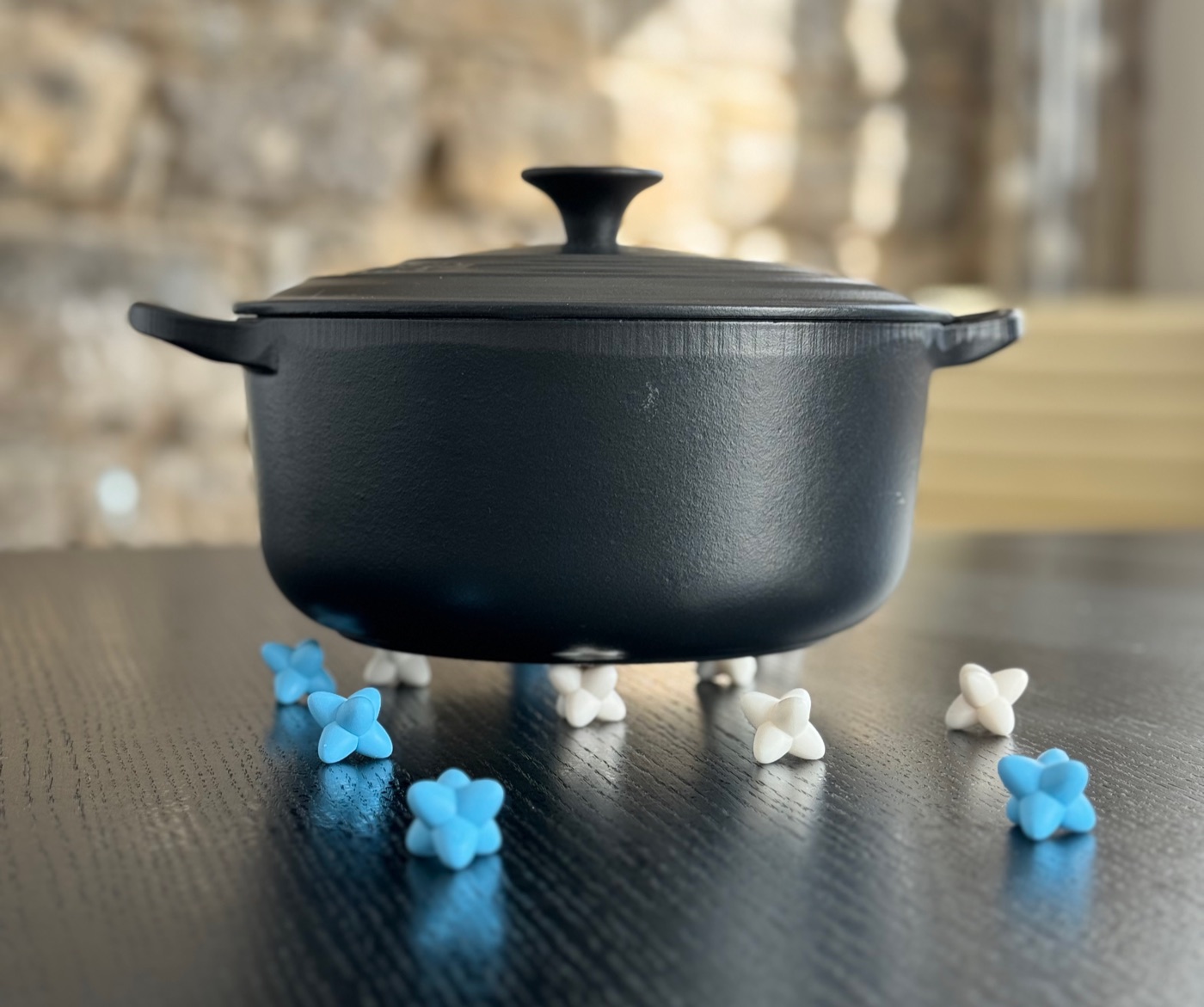
craggles are small heat-resistant silicone trivets whose shape means they always land right — four of them carry a pan of any size.
What craggles is
craggles aren't one large trivet but several small ones. They go onto the table individually, and their shape is chosen so that they always land the right way up — you can simply toss them down, no arranging needed. Four of them carry a pan of any size, or even a baking tray.
The material is heat-resistant silicone in several colours; they came packaged in a round metal tin. Created in Switzerland over ten years ago, they are the direct predecessor of creggles.
What craggles did differently
- They always land right. The shape makes arranging unnecessary — tossed down one-handed, ready immediately.
- Several small ones instead of one large. Four adapt to any pot size; a fixed trivet cannot.
- They are allowed to stay out. Designed to remain on the table rather than disappear into a drawer.
- The shape itself is protected. Alongside the word mark and the registered design there is a 3D trade mark — granted only where the shape on its own is recognisable as an indication of origin.
- The start of the chain. With craggles, MANOVIS took a product from idea to retail for the first time.
The shape, turned

The 3D view could not be loaded.
Why MANOVIS built craggles
craggles was the beginning. It was the first time MANOVIS took an idea the whole way: design, engineering, tooling, production, brand, sale. Running that chain end to end once changes how you work afterwards — you know what lies between a good drawing and an object someone buys, and how many of the decisions along the way have nothing to do with design.
That still shapes how we approach software. Insisting that easo's data belongs to the customer, or that whaaat works without an account, are decisions of the same kind as choosing the material for a trivet: they are made early, they are hard to correct later, and they determine whether what you end up with is any good.
It began with a very simple thought: you come from the kitchen to the dining table and realise the trivet is missing. That turned into a design brief with three conditions — it has to adapt to any size while taking up almost no room, it has to look good enough to stay within reach, and it has to work one-handed.
The answer was to split the job across several small pieces and choose their shape so that every position is the right position. That settles all three conditions at once: flexible, space-saving, and usable without looking.
craggles was the first product Stefan Gafner designed entirely himself — and, together with Andreas Born, brought to market: first through individual retailers, then a Swiss wholesaler, and under licence for Europe and the USA. Swiss stock was always manufactured in Switzerland. Running that chain end to end once — design, tooling, production, brand, distribution, licence — changes how you work afterwards.
craggles didn't fade because of the product but because of a business decision: MANOVIS withdrew from distribution and sold the online retail arm. The rights to craggles stayed with MANOVIS throughout — and the shape came back years later, as creggles.
Key facts
- Status
- Currently no longer manufactured
- Origin
- Designed in Switzerland over ten years ago
- Material
- Heat-resistant silicone, in several colours
- Packaging
- A round metal tin
- Production
- Swiss stock always manufactured in Switzerland
- IP
- Registered word mark, registered design and a registered 3D trade mark
- Distribution (then)
- Retailers, then a Swiss wholesaler; licensed for Europe and the USA
- Role
- The predecessor of creggles
- Website
- craggles.com is an archive today and points to creggles
Frequently asked questions
Can craggles still be bought?
Visit the sitecraggles.com